%20-%20Copy%20-%20Copy%20-%20Copy.jpg)
Position Paper | Public Release | Tinkermen Lotto Report
___________________________________________________________________
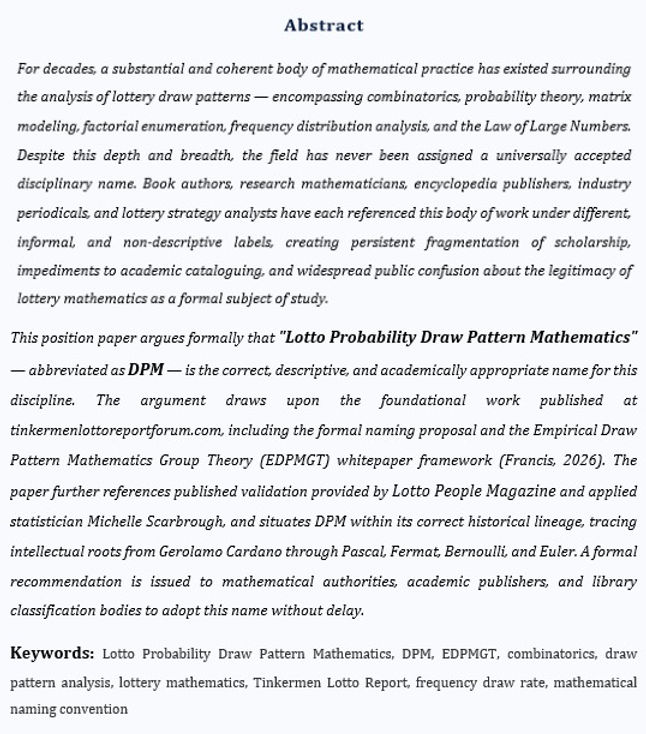
A New Name in Lotto Mathematics:
The Case for Formalizing Lotto Probability Draw Pattern Mathematics
A Formal Position Paper on the Naming Convention, Disciplinary Status,
and Foundational Framework of Draw Pattern Mathematics (DPM)
Tinkermen Lotto Report — Home of Empirical Draw Pattern Mathematics (EDPMGT)
___________________________________________________________________
AUTHOR
John Francis
Founder & Lead Researcher, Tinkermen Lotto Report
PUBLISHER
Tinkermen Lotto Report
www.tinkermenlottoreportforum.com
COLLABORATORS / VALIDATORS
Michelle Scarbrough, Applied Statistician
Terry Materese, Lotto People Magazine
DATE OF PUBLICATION
June 2026
Version 1.0 | First Edition
___________________________________________________________________
Tinkermen Lotto Report | www.tinkermenlottoreportforum.com | © 2026 All Rights Reserved
___________________________________________________________________
___________________________________________________________________
Table of Contents
Abstract
1.0 The Historical Problem: A Field Without a Name
2.0 The Unnamed Field: Scope and Existing Literature
2.1 Core Mathematical Subjects Within DPM
2.2 Exemplary DPM Model Structure Reports
3.0 Historical Foundations of the Discipline
3.1 Classical Origins: Probability Theory
3.2 The Modern Lottery Era and the Rise of Lotto Mathematics
4.0 Why This Field Qualifies as a Mathematical Discipline
4.1 Defined Subject Matter
4.2 Established Methodology
4.3 Body of Published Literature
4.4 Empirical Validation
5.0 The Case for a Formal Naming Convention
6.0 Why "Lotto Probability Draw Pattern Mathematics" Is the Correct Formal Name
6.1 Component-by-Component Analysis
7.0 The EDPMGT Framework: DPM in Formal Practice
7.1 The Tinkermen Matrix Model
7.2 Validation and Published Findings
8.0 The Seven-Part DPM Model Structure Report
9.0 Conclusion and Formal Recommendation
References
1.0 The Historical Problem: A Field Without a Name
Few intellectual disciplines present a more unusual paradox than this: a well-developed, rigorously practiced, and widely published field of applied mathematics that has persisted for more than half a century without a single universally accepted name.
This is precisely the condition that describes the body of mathematical practice applied to the analysis of lottery draw patterns — a field encompassing probability theory, combinatorics, matrix modeling, factorial enumeration, and statistical distribution analysis. Authors have written books about it. Mathematicians have published papers within it. Encyclopedia editors have attempted to summarize it. Lottery industry publications have reported on it. Software developers have built tools to operationalize it. Yet no one, across any of these domains, has ever formally named it.
The practical nomenclature that has most persistently filled this void is the informal nickname "Decades Analysis" — a term that has circulated among practitioners for many years as a shorthand reference. However, "Decades Analysis" is not a formal disciplinary name. It describes neither the mathematical nature of the inquiry, the object of analysis, nor the theoretical framework being employed. It carries no formal definition in any academic glossary, mathematical taxonomy, or library classification scheme. Its origins are vernacular, not academic, and its usage is neither consistent nor universal across the practitioner community.
An early landmark in the field's public literature was Gail Howard's 1988 publication, Lotto: How to Wheel a Fortune. This work popularized wheeling strategies — systematic methods for organizing lottery number selections into structured combinatorial sets — and introduced a large popular audience to applied mathematical thinking about lottery play. Howard's contribution was significant: it demonstrated that mathematically structured approaches to lottery selection could be explained, documented, and packaged for public consumption. Yet Howard's work, like virtually everything that followed it, did not establish a formal disciplinary name for the overarching field it represented. It named a method, not a discipline.
The consequences of this naming vacuum are substantial and multi-dimensional. First, fragmentation of scholarship: because no common disciplinary name exists, researchers and authors working within the same intellectual space cannot easily identify, reference, or build upon one another's work. A researcher investigating combinatorial lottery analysis and another investigating draw pattern frequency distribution may be operating within the same discipline without any structural mechanism to recognize that fact.
Second, the inability to catalogue resources: library classification systems — including the Dewey Decimal Classification and the Library of Congress Classification — require formal disciplinary names to place materials in consistent, retrievable locations. Without a name, DPM literature is scattered across general probability, statistics, games of chance, and self-help categories, making systematic discovery effectively impossible. Third, absence from academic curricula: no university department can include an unnamed discipline in its course catalog, and no academic journal can establish a formal review category for it.
The field's rich body of knowledge therefore remains invisible to the formal academic system, regardless of its mathematical depth. Fourth, public confusion about legitimacy: in the absence of a recognized disciplinary name, public discourse on lottery mathematics remains dominated by misconception — specifically the persistent and incorrect notion that because lotteries involve chance, their mathematical structure is inaccessible to systematic analysis. This confusion would be substantially reduced if the public, press, and policymakers had a formal disciplinary name under which to locate and evaluate the relevant scientific literature.
Critically, it must be recognized that major published documents and reports from across this field — including the Tinkermen Lotto Report series (Francis, 2026), Renato Gianella's landmark paper "The Geometry of Chance: Lotto Numbers Follow a Predicted Pattern", and Ian McPherson and Derek Hodson's "Lottery Combinatorics" — all operate substantively within the same body of mathematical practice. They employ the same foundational tools, investigate the same class of phenomena, and arrive at findings that are complementary and mutually reinforcing. Yet they do so under different terminological frameworks and without any shared disciplinary banner under which their combined contributions can be recognized, aggregated, and advanced. This paper proposes to resolve that longstanding deficiency.
2.0 The Unnamed Field: Scope and Existing Literature
Before a formal name can be justified, the scope of what is being named must be clearly established. The field informally understood as lottery draw pattern mathematics is not a narrow technical specialty. It is a substantive, multi-component domain of applied mathematics with significant breadth, empirical grounding, and practical relevance. Its intellectual scope spans from the theoretical foundations of probability and combinatorics through applied statistical modeling, matrix construction, color-coded classification systems, and large-scale empirical analysis of historical lottery draw data.
2.1 Core Mathematical Subjects Within DPM
The mathematical toolkit deployed within Lotto Probability Draw Pattern Mathematics is extensive. The following subjects each play a definable and essential role in the discipline's analytical framework:
-
Addition, Subtraction, Multiplication, Division — The arithmetic bedrock upon which all higher-order DPM calculations rest, including frequency tallying, ratio computation, and percentage derivation.
-
Matrices — Matrix structures are used to organize and model the combinatorial space of a given lottery, mapping each draw pattern group to its corresponding set of possible combinations.
-
Mathematical Notation — Formal notation systems enable the precise, unambiguous expression of combinatorial and probabilistic relationships within and across lottery matrices of different sizes.
-
Statistics — Descriptive and inferential statistical methods are applied to historical draw data to measure actual draw frequencies, identify deviation from theoretical expectation, and establish empirical baseline behavior.
-
Probability — The foundational engine of DPM. Probability theory governs the expected frequency of each draw pattern group as a proportion of all possible outcomes within a defined lottery sample space.
-
Combinatorics — The systematic enumeration of lottery combinations is the primary structural task of DPM. Combinatorics determines how many distinct combinations belong to each draw pattern group and provides the theoretical frequency baseline against which empirical draws are measured.
-
Sample Space — Defining the complete sample space of a lottery — the total number of possible draw outcomes — is a prerequisite for all subsequent probability and combinatorial calculations.
-
Color Schemes — A practical classification tool unique to DPM, in which draw pattern group types are assigned color identifiers to enable rapid visual differentiation and pattern-tracking across historical draw records.
-
Binomial Distribution — Used in the analysis of binary outcome characteristics within draw patterns, binomial distribution models inform expectations about how often specific structural combination types will appear over defined drawing periods.
-
Law of Large Numbers — As the number of lottery draws increases toward the theoretical total, the observed frequency of each draw pattern group converges toward its theoretical probability. This principle underlies all long-term empirical validation of DPM predictions.
Of these subjects, combinatorics and probability theory represent the twin cores of the discipline — the twin intellectual pillars upon which all other DPM analysis rests. Together they define the structure of the lottery's combinatorial space and govern the expected behavior of draw pattern groups within that space over time.
To illustrate the role of combinatorics at its most foundational: consider the numbers 1, 2, and 3. The number of distinct permutations of these three values is calculated as 3 factorial — written 3! — which equals 3 × 2 × 1 = 6. This elementary operation scales directly to the lottery context: when a lottery requires players to select, say, six numbers from a pool of forty-seven, the total number of distinct combinations — the sample space — is computed using the combinatorial formula C(47,6) = 10,737,573. It is the systematic application of this factorial and combinatorial logic across a lottery's full number pool that enables the enumeration and classification of draw pattern groups within DPM. This is not trivial arithmetic; it is structural mathematics that directly defines the scope and composition of every draw pattern category within the discipline.
2.2 Exemplary DPM Model Structure Reports
Three foundational published works stand as representative exemplars of DPM analysis operating in full scholarly form, each contributing to the collective literature of the field, and each validating the breadth and rigor of the discipline as defined in this paper:
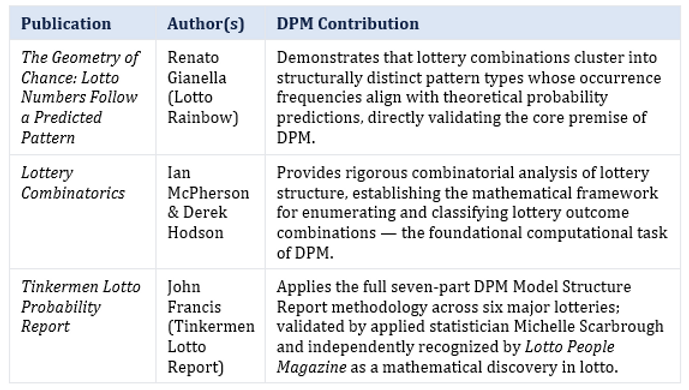
That three independently developed bodies of work, produced by authors across different countries and contexts, arrive at mutually compatible findings using substantially the same mathematical toolkit is powerful evidence that they are describing the same underlying discipline — a discipline that now requires, and merits, a formal name.
3.0 Historical Foundations of the Discipline
Lotto Probability Draw Pattern Mathematics did not emerge without intellectual antecedents. Its theoretical foundations are rooted in some of the most celebrated developments in the history of mathematics. Understanding this lineage is essential to properly situating DPM within the broader taxonomy of mathematical knowledge and to substantiating its claim to formal disciplinary status.
3.1 Classical Origins: Probability Theory
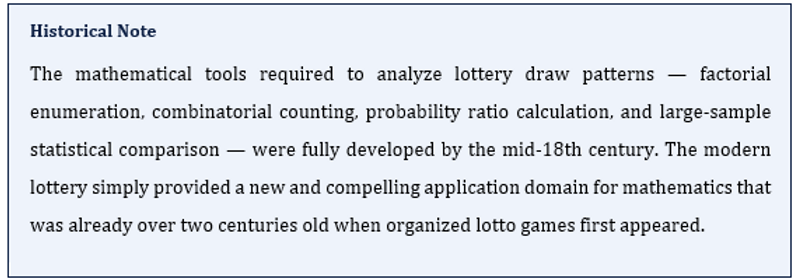
The intellectual history of DPM more formally begins with Gerolamo Cardano (1501–1576), the Italian polymath whose posthumously published work Liber de ludo aleae (Book on Games of Chance, written c. 1564, published 1663) stands as one of the first known systematic treatments of probability in the context of games of chance. Cardano introduced the concept of enumerating outcomes and comparing favorable outcomes to total possibilities — the fundamental operation that underlies all probability calculations. His work established that the mathematics of chance was a legitimate subject of rigorous inquiry, not merely a matter of superstition or intuition.
A century later, the famous correspondence between Blaise Pascal and Pierre de Fermat in 1654 — prompted by practical gambling questions posed by the Chevalier de Méré — produced the foundational framework of classical probability theory. Their exchange formalized the concepts of expected value, the probability of compound events, and the enumeration of outcomes in combinatorial scenarios. Pascal's arithmetic triangle (Pascal's Triangle) provided a systematic tool for computing binomial coefficients — the same mathematical structure that appears in lottery combination enumeration. This correspondence is widely regarded as the birth of probability theory as a formal mathematical discipline.
Christiaan Huygens further developed these ideas in his 1657 treatise De Ratiociniis in Ludo Aleae (On Reasoning in Games of Dice), producing the first formal published text on probability theory and establishing the concept of expected value in rigorous mathematical terms.
The discipline was substantially advanced by Jacob Bernoulli, whose posthumously published masterwork Ars Conjectandi (1713) introduced the Law of Large Numbers in formal mathematical terms — the principle that as the number of observations increases, the empirically observed relative frequency of an event converges toward its theoretical probability. This law is not merely an ancillary concept within DPM; it is the foundational principle that makes empirical validation of draw pattern frequency predictions possible and mathematically meaningful.
Leonhard Euler, the preeminent mathematician of the 18th century, made substantial contributions to combinatorics and graph theory that further enriched the mathematical toolkit available to the field. Together, these thinkers — Cardano, Pascal, Fermat, Huygens, Bernoulli, and Euler — constitute the intellectual historic lineage from which Lotto Probability Draw Pattern Mathematics descends.
3.1 Classical Origins: Probability Theory
Modern government-operated lotteries began to emerge in the 1960s and proliferated significantly through the 1970s as legislative frameworks changed across North America and Europe to permit or expand state-sponsored lottery operations. This proliferation created both a public appetite for mathematically informed lottery strategy and a new empirical data set — millions of documented draw outcomes — upon which analytical frameworks could be built and tested.
It was during this period that the first wave of lotto mathematics books appeared, largely focused on wheeling strategies and structured selection systems. These publications — of which Gail Howard's 1988 Lotto: How to Wheel a Fortune is a prominent example — drew directly on the combinatorial tradition established by Bernoulli, Euler, and Pascal, applying it to the specific structural problem of organizing lottery number selections into mathematically efficient covering sets. This body of literature, while practically oriented, represented genuine applied mathematics. It built, organically and without formal institutional recognition, the embryonic corpus of what this paper formally identifies as Lotto Probability Draw Pattern Mathematics.
The intellectual trajectory of the field migrated from Europe to the United States in the early 1970s, tracking the westward expansion of government lottery programs and building upon the European probability tradition. Across subsequent decades, the field accumulated practitioners, publications, and analytical methods — growing into a substantive discipline that, through accident of history and the absence of academic institutional sponsorship, simply never received the formal name it deserved.
4.0 Why This Field Qualifies as a Mathematical Discipline
The recognition of any intellectual body of knowledge as a formal discipline typically requires that it satisfy a set of structural criteria: that it possess a defined and bounded subject matter, an established and reproducible methodology, a body of published literature, and a record of empirical validation. Lotto Probability Draw Pattern Mathematics satisfies all four criteria robustly, as demonstrated below.
4.1 Defined Subject Matter
DPM has a clearly bounded object of study: the structural, combinatorial, and probabilistic behavior of lottery draw patterns across time and across different lottery matrices.
This is not a vague or expansive subject. A lottery draw pattern, as defined within DPM, describes the structural grouping of lottery outcome number combinations according to their combinatorial composition — specifically, how the numerical values selected in a draw are distributed across the defined number ranges or structural segments of a lottery's number pool. This structural grouping is mathematically determinate, exhaustively enumerable, and analytically distinct from the study of individual number frequencies, which belongs to a different analytical tradition.
The object of study in DPM is therefore not "lottery numbers" in general — it is the pattern structure of lottery combinations, and the probabilistic and empirical behavior of defined pattern groups over time. This represents a specific, disciplinarily coherent subject of inquiry, precisely bounded by its combinatorial and probabilistic definition.
4.2 Established Methodology
DPM employs a reproducible, multi-step methodology that is consistently applied across practitioners, publications, and analyses regardless of which specific lottery is under examination. This methodology includes:
-
Factorial and combinatorial enumeration of all possible combinations within the lottery's sample space
-
Draw pattern group classification, in which every possible combination is assigned to a structurally defined pattern group type
-
Theoretical frequency calculation (Frequency Draw Rate), establishing the expected proportion of draws that should fall within each pattern group over the long run
-
Matrix modeling, which maps the complete combinatorial structure of a lottery into a set of defined pattern group matrices
-
Color-coded pattern classification, providing a visual and categorical system for tracking draw pattern behavior across historical records
-
Empirical frequency distribution analysis, comparing actual observed draw pattern occurrence to theoretical expectation
-
Statistical comparison of empirical versus theoretical draw rates, identifying pattern groups that are overrepresented, underrepresented, or aligned with expectation at any point in a lottery's draw history
This methodology is not ad hoc or analyst-dependent. It is a structured, systematic protocol that any competent mathematician could apply independently to any lottery and arrive at consistent results. Reproducibility and consistency of method are hallmarks of a legitimate scientific discipline.
4.3 Body of Published Literature
Over more than 30 years — from Howard (1988) through Gianella's Geometry of Chance, McPherson and Hodson's Lottery Combinatorics (2009), to the initial development of the Tinkermen Lotto Report series (2002) then through more formal publishing (2020) (Francis, J) — a substantial body of published literature has addressed the subject matter of DPM using its core methodology.
This literature spans books, research papers, online publications, software systems, and now (2026) a formal whitepaper series. That this literature has not been catalogued under a single disciplinary name is precisely the problem this paper addresses — but the existence of the literature is beyond dispute, and its mathematical substance is fully commensurate with the standards of published applied mathematics.
4.4 Empirical Validation
The most rigorous test of any applied mathematical framework is empirical: does it correctly predict the behavior of the phenomena it models? The Empirical Draw Pattern Mathematics Group Theory (EDPMGT) framework, developed by John Francis at the Tinkermen Lotto Report, has achieved over 90% correct draw pattern group prediction accuracy across seven major lotteries since 2021:
-
Mega Millions
-
Powerball
-
Euro Millions
-
California Super Lotto Plus
-
Millionaire for Life
-
Lotto America
-
Lucky for Life (Ended 2026)
-
This validation does not come from any individual reviewer; it arises from the empirical record itself. The observed draw data consistently aligns with the mathematical structure predicted by the EDPMGT framework. Independent applied statistician Michelle Scarbrough has previously reviewed and analyzed the Tinkermen Lotto Report methodologies, and Lotto People Magazine has published commentary recognizing the significance of this empirical alignment.
The breadth of this validation — spanning lotteries of different matrix sizes, number pool configurations, and bonus ball structures — demonstrates that the underlying analytical framework captures a genuine and universal mathematical property of lottery draw behavior, not an artifact of any single lottery’s specific design.
The confirmation comes from the mathematics lining up with the empirical draw data. In applied mathematics, this is the highest standard of verification: when a theoretical model predicts structural outcomes before they occur, and the real‑world data repeatedly falls into the exact pattern‑group distributions the model anticipates. This convergence between theory and observation is what establishes the legitimacy of an applied principle. It shows that the framework is not merely descriptive, but predictive — revealing an underlying order in the draw process that persists across different lotteries, formats, and number matrices.
The analogy to other named disciplines is instructive and directly applicable: just as Einstein's Special Theory of Relativity is a formally named discipline that encompasses hundreds of mathematical equations, sub-components, and derivative analytical frameworks, Lotto Probability Draw Pattern Mathematics encompasses many mathematical parts — combinatorics, probability theory, matrix modeling, statistical frequency analysis, the Law of Large Numbers — that together form a unified, nameable, and formally coherent discipline.
A name does not simplify or reduce the complexity of a discipline; it provides the intellectual container within which that complexity can be recognized, organized, taught, and advanced. DPM merits that container.
5.0 The Case for a Formal Naming Convention
The act of formally naming a mathematical discipline is not merely ceremonial or administrative. It is a functional necessity — one that directly determines whether a body of knowledge can be found, taught, built upon, and trusted by the broader scientific and public communities. Academic and practical naming conventions serve a critical and multi-faceted function in the organization of human knowledge, and the absence of such a convention in any mature field represents a genuine structural deficiency that compounds over time.
Consider the precedent: every recognized mathematical subdiscipline carries a formal name that describes its subject matter with precision. Differential Calculus identifies both the mathematical operation (differentiation) and the type of inquiry (calculus). Stochastic Processes names the object of study (processes governed by probability). Number Theory names the mathematical domain. Algebraic Topology specifies both the structural framework and the domain of application. In each case, the name performs essential intellectual work: it orients the researcher, defines the scope, and signals the methodological tradition. The name is not incidental to the discipline; it is part of the discipline's formal definition.
A proper naming convention for the discipline under consideration must, by the same logic, encode four essential informational components:
-
The specific subject domain — What class of phenomena is being studied?
-
The core mathematical property being investigated — What mathematical principle governs the inquiry?
-
The specific object of analysis — What is the unit of analysis that defines the discipline's unique contribution?
-
The type of inquiry — Is this mathematics, science, statistics, or something else?
The informal nickname "Decades Analysis", that's been sometimes used since the 1970s, fails all four of these criteria simultaneously. It is geographically and temporally ambiguous — the word "decades" evokes time periods, not mathematical structures. It is non-descriptive of mathematical content — nothing in the term signals probability, combinatorics, or any other mathematical property. It has no formal definition in any academic, professional, or library context. And it provides no classification signal to indicate whether the inquiry is mathematical, statistical, actuarial, or something else entirely. As a disciplinary name, it is thoroughly inadequate — a practitioner's shorthand, not a scientific designation.
The practical benefits of formalizing the name are substantial and immediate. A formally named discipline enables:
-
Academic recognition — Departments, journals, and conferences can formally include or reference the discipline by name
-
Textbook inclusion — Academic publishers can commission, categorize, and market textbooks within the named discipline
-
Library cataloguing — Dewey Decimal Classification and Library of Congress Classification can assign consistent call number ranges, making DPM literature systematically discoverable
-
Curriculum development — Universities and professional certification bodies can develop and list formal courses within the discipline
-
Peer review infrastructure — Academic journals can establish formal review categories, enabling rigorous peer-reviewed publication of DPM research
-
Public trust — A formally recognized disciplinary name communicates to the general public, press, and policymakers that the subject of lottery draw pattern mathematics is a legitimate scientific inquiry — not a commercial scheme or pseudoscience
Each of these benefits compounds over time. Every year that passes without a formal name is a year in which DPM literature goes uncatalogued, DPM courses go untaught, and DPM research goes unpublished in peer-reviewed venues. The naming of this discipline is not an academic formality — it is a prerequisite for the discipline's proper development and public use of its legitimacy.
6.0 Why "Lotto Probability Draw Pattern Mathematics" Is the Correct Formal Name
This section makes the affirmative case that the proposed name — Lotto Probability Draw Pattern Mathematics — is not merely a reasonable choice, but the correct, descriptive, and formally appropriate designation for this discipline. The argument proceeds component by component, demonstrating that each word in the proposed name carries irreplaceable informational content, and that no simpler or alternative formulation carries equivalent precision.
6.1 Component-by-Component Analysis
Lotto - Identifies the specific application domain "Gambling Mathematics" is too broad, encompassing poker, blackjack, sports betting, and roulette. "Lottery Statistics" is reductive — it implies only descriptive statistics, omitting combinatorics and probabilistic modeling. "Lotto" is universally recognized, culturally specific, and discipline specific. It immediately orients the reader to the correct subject domain without ambiguity.
Probability - Captures the mathematical nature of the field Probability theory is the foundational engine of all DPM analysis. It governs the expected frequency of each draw pattern group, validates empirical findings against theoretical baselines, and provides the mathematical backbone for the Law of Large Numbers applications within the discipline. Without "Probability," the name fails to signal the discipline's mathematical tradition. It distinguishes DPM from pure statistics (which is descriptive and inferential but not necessarily probabilistic) and from pure combinatorics (which is enumerative but not stochastic).
Draw Pattern - Names the specific object of analysis. This two-word phrase is the intellectual core of the entire proposed name. A "draw pattern" describes the structural grouping of lottery outcome number combinations according to their combinatorial composition — the unique unit of analysis that definitively separates DPM from general lottery statistics or number frequency analysis. It is not a synonym for "lottery outcome" or "winning numbers." It is a precisely defined analytical construct that is specific to this discipline. The phrase encodes what DPM actually studies, in terms that no other discipline uses for any other purpose.
Mathematics - Classifies the discipline within the taxonomy of human knowledge. DPM is not a strategy, not a system, not a predictive service, and not a form of gambling advice. It is a branch of applied mathematics — rigorously grounded in formal mathematical theory, employing reproducible quantitative methods, and producing empirically testable predictions. "Mathematics" is the correct disciplinary classification word. It places DPM within the correct intellectual family, signals the appropriate methodological standards, and establishes the appropriate academic institutional home.
The structural logic of the proposed name precisely mirrors the logic of other formally recognized named disciplines. Consider Einstein's Special Theory of Relativity: this name encodes a domain modifier ("Special"), a theoretical framework type ("Theory"), and a subject descriptor ("Relativity"). Each component performs a specific informational function; remove any one component and the name loses essential precision. The same logic applies to the proposed name for DPM.
No component of this name is decorative. No component can be removed without a material loss of precision. No alternative formulation captures all four necessary informational dimensions with equivalent specificity. This is the correct formal name for the discipline, and it is the name this paper formally proposes for universal adoption.
7.0 The EDPMGT Framework: DPM in Formal Practice
A named discipline requires not only a name but a formal theoretical framework within which its methodology is rigorously defined, applied, and tested. Lotto Probability Draw Pattern Mathematics has such a framework: the Empirical Draw Pattern Mathematics Group Theory, designated by its abbreviation EDPMGT, and formally introduced by John Francis at the Tinkermen Lotto Report in the whitepaper series published June 2026 (Version 1.0).
EDPMGT provides the formal theoretical scaffolding that operationalizes DPM at its highest level of precision. It defines, in rigorous mathematical terms, how lottery draw outcomes cluster into structurally distinct pattern group types, each characterized by a measurably different Frequency Draw Rate (FDR) — the theoretically derived probability that a randomly selected lottery draw will produce a combination belonging to that pattern group.
The FDR is not a statistical estimate; it is a mathematical certainty derivable from the combinatorial structure of the lottery's sample space. The empirical question — the question EDPMGT answers — is whether actual historical draw data converges toward this theoretical expectation in a manner consistent with the Law of Large Numbers.
7.1 The Tinkermen Matrix Structure Model
Central to the EDPMGT framework is the Tinkermen Matrix Structure Model — a mathematical model that maps the complete combinatorial space of a lottery into its defined draw pattern groups. It should be noted that the matrix model concept itself is not a proprietary invention; lottery probability structure matrix models have been a standard practice among math enthusiasts within lotto mathematics since approximately the 1970s, though this understanding has never been formally researched or academically documented for the most part.
The Tinkermen Matrix Structure Model represents the author's formal named implementation of this established concept, applied specifically within the EDPMGT framework. The Matrix Structure Model serves three functions within EDPMGT:
-
Structural mapping — It establishes a complete, exhaustive partition of the lottery's sample space into mutually exclusive draw pattern group types, ensuring that every possible combination belongs to exactly one group.
-
Theoretical baseline establishment — For each draw pattern group, the Matrix Model computes the theoretical FDR — the exact probability that a random draw will produce a combination within that group — enabling meaningful empirical comparison.
-
Analytical enablement — The Matrix Model provides the structured framework within which combinatorial mathematics can be applied to enumerate all possible combinations within each pattern group, enabling full combinatorial analysis at the group level rather than only at the level of individual numbers.
-
The EDPMGT whitepaper series (Francis, 2026) formally introduces the framework, grounded rigorously in combinatorics, probability theory, and the Law of Large Numbers. A companion comparative analysis paper — 'DPM Applied: A Comparative Draw Pattern Mathematics Analysis Across Six Major Lotteries' applies EDPMGT across major lotteries and confirms a finding of profound significance: universal clustering behavior exists regardless of lottery matrix size, number pool configuration, or bonus ball structure.
This finding demonstrates that the draw pattern group phenomenon is not a property of any particular lottery's design — it is a mathematical property of all combinatorial lottery structures, arising inevitably from the mathematics of combination enumeration.
7.2 Validation and Published Findings
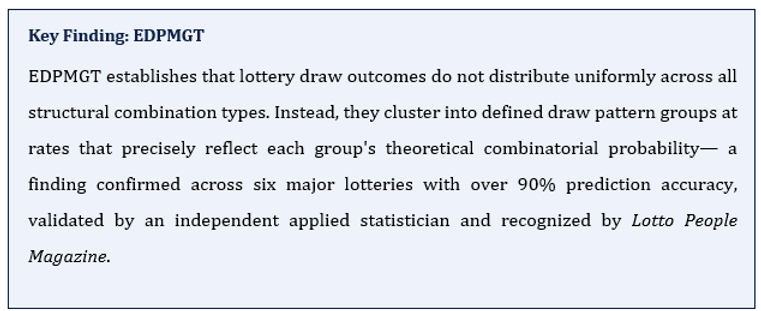
The EDPMGT framework has been subjected to external validation. Applied statistician Michelle Scarbrough has reviewed the methodology and findings of the Tinkermen Lotto Report series and provided professional validation of the analytical framework and its results. An over 90% correct draw pattern group prediction public accuracy record has also been achieved across seven major lotteries, representing a substantial empirical record that goes well beyond proof-of-concept.
Lotto People Magazine, a recognized industry publication, has provided independent published commentary on the EDPMGT findings, (2002) stating:

This statement, from an independent industry source with no financial or institutional stake in the Tinkermen Lotto Report's findings, represents precisely the kind of external validation that distinguishes a genuine mathematical discovery from an unsubstantiated analytical claim.
Lotteries have long been assumed by the general public — and often by commentators who should know better — to be entirely random events in which every combination has an equal probability and no mathematical structure can be discerned.
EDPMGT's empirical findings demonstrate that while individual number selection outcomes are indeed random, the structural pattern types of lottery combinations behave in a predictable, mathematically deterministic fashion at the group level, in full conformity with the combinatorial probability distribution predicted by theory.
8.0 The Seven-Part DPM Model Structure Report
A defining feature of a mature mathematical discipline is the existence of a canonical analytical document format — a standardized report structure that embodies the discipline's methodology in an organized, reproducible, and comprehensive form.
Within Lotto Probability Draw Pattern Mathematics, this canonical format is the Lotto Probability Draw Pattern Mathematics Model Structure Report, as formally defined by the Tinkermen Lotto Report. This seven-part structure represents the complete operationalization of DPM methodology applied to a specific lottery, and its seven components together constitute a full analytical record of the lottery's draw pattern behavior, theoretical framework, and combinatorial architecture.
The seven components are as follows:
Component 1: Past Draws Page
The Past Draws Page provides the empirical foundation of the DPM analysis. It separates and organizes all past lottery draws by their draw pattern group type and associated color classifications, creating a structured historical record that makes the distribution of draw outcomes across pattern groups immediately visible. This page is the primary evidentiary base for all subsequent comparative analysis, enabling direct visual inspection of how historical draw outcomes are distributed across the defined pattern group types.
Component 2: Statistics Page
The Statistics Page is the core analytical component of the report. It compares, for each draw pattern group, the number of times that group has actually occurred in historical draws against its theoretical expected value — the Frequency Draw Rate — computed from the lottery's combinatorial structure. Discrepancies between actual and expected frequencies are quantified and presented, enabling identification of pattern groups that are statistically overdue, ahead of expectation, or within normal variance range.
Component 3: Draw Order Page
The Draw Order Page organizes past draws chronologically within each draw pattern group type, providing temporal analysis capability that complements the aggregate statistical view of the Statistics Page. By examining the sequence in which different draw pattern groups have appeared over time, analysts can identify temporal clustering, spacing patterns, and sequential relationships between pattern group occurrences — analytical dimensions that are invisible in aggregate statistics alone.
Component 4: Mathematics Model Page
The Mathematics Model Page provides the complete formal mathematical foundation of the analysis. It details the full mathematical model structure: the combinatorial count for each draw pattern group (the exact number of combinations belonging to each group), and the theoretical percentage — the Frequency Draw Rate — at which each pattern should appear over time as a proportion of all possible draws. This page makes explicit the mathematical derivation that underlies all other components of the report, enabling verification of the theoretical baseline by any competent mathematician.
Component 5: Matrix Model Page
The Matrix Model Page is the structural core of the Tinkermen Matrix Model. It provides model structures for each draw pattern group type, presenting the organizational framework from which combinatorial mathematics can be applied to enumerate all possible combinations within each group. The Matrix Model Page makes the complete combinatorial architecture of the lottery's draw pattern space visually and analytically accessible, enabling analysts to work with any specific pattern group as a bounded combinatorial set.
Component 6: Legend Page
The Legend Page is the methodological documentation component of the report. It documents the attributes, classification rules, color schemes, and methodological conventions used to construct the probability report. The Legend ensures that the report is fully self-documenting — that any reader, regardless of their prior familiarity with the specific report format, can understand the classification scheme, verify the attribution of draws to pattern groups, and reproduce the analytical process independently. The Legend is essential to the report's reproducibility and to the discipline's broader claim to methodological consistency.
Component 7: Chart Page
The Chart Page provides a visual analytical representation of draw pattern behavior over time, enabling identification of conditions under which certain draw patterns may be statistically overdue, trending toward expected frequency, or deviating meaningfully from theoretical prediction. Charts translate the quantitative findings of the Statistics Page into a visual format that facilitates rapid pattern recognition and supports communication of findings to audiences who may not be fully conversant in the underlying mathematics.
Together, these seven components constitute a complete analytical instrument. No component is redundant; each serves a distinct analytical function. The seven-part structure reflects the full scope of DPM methodology, from empirical data organization through theoretical modeling to visual analysis and methodological documentation. Its standardization across the Tinkermen Lotto Report series is a further marker of the discipline's maturity and the readiness of its methodology for formal academic recognition.

9.0 Conclusion and Formal Recommendation
The argument set forth in this position paper may be stated with concision. A substantial, mathematically rigorous, empirically validated, and widely practiced body of applied mathematical knowledge has existed for decades. It possesses a clearly bounded subject matter, an established and reproducible methodology, a body of published literature spanning more than thirty years, and a formal theoretical framework that has achieved over 90% empirical prediction accuracy across six major international lottery systems.
It traces its intellectual lineage to the foundational figures of probability theory — Cardano, Pascal, Fermat, Huygens, Bernoulli, and Euler. It has been practiced by mathematicians, analysts, authors, and software developers across multiple countries and across multiple decades. And it has, throughout all of this, been denied the one thing that every comparable body of mathematical knowledge possesses and requires: a formal name.
That deficiency ends with this paper.
The formal name for this discipline is Lotto Probability Draw Pattern Mathematics. The accepted abbreviation in academic and professional contexts is DPM. The specific formal theoretical framework operating within this discipline is the Empirical Draw Pattern Mathematics Group Theory, designated by the abbreviation EDPMGT.
These designations are not proposed arbitrarily. Each component of the full name — "Lotto," "Probability," "Draw Pattern," "Mathematics" — encodes an essential and irreplaceable informational dimension. Together, they constitute the minimum specification required to identify the discipline's domain, its mathematical foundation, its specific object of analysis, and its disciplinary type. No alternative formulation captures all four dimensions with equivalent precision or descriptive accuracy.
___________________________________________________________________
Formal Recommendation
This paper issues a formal recommendation to the following bodies and communities, requesting immediate and coordinated action to adopt the proposed name in all relevant professional, academic, and institutional contexts:
-
The mathematical research community — to recognize DPM as a formally named applied mathematical discipline and to adopt the name "Lotto Probability Draw Pattern Mathematics" in all relevant publications, reviews, and citations.
-
Academic publishers and journal editors — to establish formal review categories, manuscript classifications, and indexing keywords for DPM, enabling peer-reviewed publication of research within the discipline.
-
Library classification bodies — specifically the Library of Congress Classification Office and the Dewey Decimal Classification editorial team — to assign consistent, discoverable classification codes to materials within the discipline of Lotto Probability Draw Pattern Mathematics.
-
Encyclopedia editors — including those responsible for mathematical, statistical, and applied science reference works — to include formal entries for "Lotto Probability Draw Pattern Mathematics," "DPM," and "EDPMGT," replacing or supplementing any prior informal references to this body of knowledge under non-descriptive alternative terms.
-
Lottery industry stakeholders — including regulatory bodies, industry publications, and professional associations — to adopt the formal disciplinary name in communications about lottery mathematics research, thereby signaling the industry's recognition of DPM as a legitimate applied science.
-
University mathematics and statistics departments — to consider the development of formal courses, seminar programs, and research tracks within the named discipline of DPM, drawing upon the published literature and the EDPMGT framework as foundational course material.
In addition to these institutional recommendations, this paper calls for expanded peer review, active academic collaboration, and accelerated publication of DPM research under the newly formalized disciplinary name.
The Tinkermen Lotto Report commits to supporting this process through continued publication of EDPMGT whitepaper series installments, comparative analysis papers, and the ongoing development and public availability of additional DPM Model Structure Reports across major international lottery systems moving forward.
Mission Statement
The mission of the Tinkermen Lotto Report has always been singular in its clarity: to replace myths about the lottery with evidence-based mathematical reality, and to build public trust in the legitimate, rigorous, and empirically grounded study of lotto probability draw pattern behavior. That mission is inseparable from the formal recognition of DPM as a named discipline. So long as the field lacks a name, it lacks the institutional legitimacy required to reach the public, the academy, and the broader scientific community in the way its substance deserves.
The naming of a discipline is an act of intellectual maturation. It is the moment at which a body of knowledge ceases to be a collection of individual contributions and becomes a recognized field of inquiry — a field that can be taught, catalogued, published, debated, and built upon by future generations. Lotto Probability Draw Pattern Mathematics has earned that moment. It has the history, the methodology, the literature, and the empirical record to stand as a formally recognized applied mathematical discipline. It requires only the name.
That name is now formally proposed, argued, and recommended:
Lotto Probability Draw Pattern Mathematics — DPM.
Tinkermen Lotto Report Database Repository
References
Bernoulli, J. (1713). Ars Conjectandi. Basel: Thurnisius.
Cardano, G. (c. 1564). Liber de ludo aleae [Book on games of chance]. (Posthumously published 1663.)
Francis, J. (2026). Empirical Draw Pattern Mathematics Group Theory: A new mathematical framework for understanding lottery draw pattern structure models (Version 1.0). Tinkermen Lotto Report. Retrieved from tinkermenlottoreportforum.com
Gianella, R. (2014). The geometry of chance: Lotto numbers follow a predicted pattern. Lotto Rainbow. Retrieved from lottorainbow.com
Howard, G. (1988). Lotto: How to wheel a fortune. New York: Gail Howard.
Huygens, C. (1657). De ratiociniis in ludo aleae [On reasoning in games of dice]. In F. van Schooten (Ed.), Exercitationum Mathematicarum. Leiden: Elsevier.
Lotto People Magazine. (2026). Validation statement on EDPMGT. [As cited in Tinkermen Lotto Report White Paper Series, 2026.]
McPherson, I., & Hodson, D. Lottery combinatorics. [Publication details as documented in Tinkermen Lotto Report citation records.]
Pascal, B., & Fermat, P. de. (1654). Correspondence on probability theory. [Various translations and compilations; see David, F. N. (1962). Games, Gods and Gambling. London: Charles Griffin.]
Tinkermen Lotto Report. (2026). A proposed new name in lotto mathematics. Retrieved from tinkermenlottoreportforum.com/proposal
___________________________________________________________________

Authorship, Rights, and Access
This position paper was authored and produced by John Francis, Founder of the Tinkermen Lotto Report, as part of the organization’s ongoing research program in empirical lottery mathematics. The work reflects more than two decades of applied analysis, database modeling, and theoretical development across multiple world lotteries.
This publication is released under a free‑to‑download, non‑commercial use license. Readers may cite, reference, and distribute this document for research, academic study, and public education, provided attribution is maintained.
The official PDF edition can be accessed and downloaded via the link below:
A New Name in Lotto Mathematics: The Case for Formalizing Lotto Probability Draw Pattern Mathematics
DOI: https://doi.org/10.6084/m9.figshare.32811221
Francis, J. (2026). Position Paper for A New Name in Lotto Mathematics: The Case for Formalizing Lotto Probability Draw Pattern Mathematics. Tinkermen Lotto Report Research Division.
______________________________________________________
View/Download the Full Whitepaper No. 1
For the complete theoretical framework of EDPMGT, formal definitions, and empirical validation, download the official whitepaper No. 1 via the link below:
Empirical Draw Pattern Mathematics Group Theory (EDPMGT)
Tinkermen Lotto Report | www.tinkermenlottoreportforum.com | © 2026 All Rights Reserved
A New Name in Lotto Mathematics | John Francis | June 2026 | Version 1.0